Showing posts with label emarketing. Show all posts

Wednesday, October 19, 2011

Putting out a welcome mat in the digital world

"Hello. Welcome. Good to meet you. I hope you enjoy your time with us." These phrases are regarded as a common courtesy in daily personal interactions, yet they are not carried over into the digital space. In a virtual world, where people are 'meeting' and engaging with brands for the first time, it has become imperative that brands 'set the stage' by initiating an email welcome campaign for new customers. This establishes trust, expectations and communicates important information about the brand.

What happens when a customer signs up for a service or purchases a product from your organisation within an ecommerce environment? In many instances they are sent a proof of order or purchase. When signing up for regular newsletter communications, an online confirmation is also sent, followed by an email requesting that the customer confirm their registration. These transactional notifications serve an important purpose, but cannot replace the value of providing a customer with an orientation on what to expect of future interactions with your company.

An email 'welcome' communication series is vital, as it opens a dialogue with your customers and is an opportune time to gather feedback on their preferences. This can be done through surveys, polls and setting up of online preferences, enabling targeted communications that will keep your customers engaged in the future.


More than just a welcome...


Welcome campaigns should be designed according to the complexity of your service offering. As an example; I recently signed up with a popular rewards program for an international airline. After initiating the relationship, I received a 6 part welcome series. The series was sent to me over a 20 day period with each email addressing a different aspect of the service - thus orienting me one step at a time.

If a customer has registered for a service that includes multiple communication types from your organisation like an eBill, transactional mail, newsletters, special offers etc, inform your customer about these communications and when they can typically expect to receive them.

Failing to address these important areas is a lost opportunity at a time when a customer's engagement with your brand is at a peak – it is now that they are more likely to open and click-through.


Basic rules to remember when introducing a welcome campaign to your customer communication lifecycle:


  • Use a clear, branded 'from' address
  • Demonstrate how to add your 'from' address to the safe sender's list
  • Include the word 'welcome' in the subject line
  • Get the information needed to personalise the salutation - it's a fact that personalised welcome emails are more effective
  • Send your welcome mail as soon after registration / interaction with your company as possible - the more time left between the initial customer contact and the welcome mail, the lower the open and click through rates
  • Use this opportunity to engage with your customer through other channels e.g. following company on social media, downloading mobile applications etc

Without a warm welcome and a friendly tour of your home, your new guests may feel lost and not stay very long – in fact, they will probably find the back door and make a quick exit. Don't let the same thing happen to your new customers.

Nicola Els
striata.com

Thursday, September 22, 2011

Dedicated IP or shared?

The effectiveness of your email marketing campaigns could be related to your decision to use either a dedicated or shared Internet Protocol (IP) address.

One of the key challenges of deliverability is achieving and maintaining an excellent sender reputation with ISPs and Webmail service providers. Your sender reputation is one of the deciding factors of whether to block your emails or let them through.

Sender reputation is associated with a sender's IP address – the theory is: if you have a good sender reputation your IP address can be trusted, which equals valid email and a higher delivery potential. There are many additional factors that can affect deliverability, but let's zoom in on the specific issue of dedicated vs. shared IP.

Understanding the implications of a shared IP address

If you are using an ESP to deliver your email marketing campaigns, it's likely that your emails are being sent from a shared IP address used by multiple clients on that system and infrastructure.

Sharing an IP address has many benefits, but there are certain risks too – which a reputable ESP should be managing on your behalf anyway.

The good and the bad of a shared IP address:

  • Good sender reputation is developed by consistently sending email, ensuring the bounce rate is kept low and the interaction is high (opens and clicks). If you are not a consistent email sender – sharing an IP enhances your sender reputation by leveraging off other senders on the same IP.
  • A good reputation is also derived by adhering to email best practice - benefitting you if these sound policies are adopted by all the senders sharing the IP.
  • The flipside of sharing is that you are at risk of other senders behaving badly and should the shared IP earn a poor sender reputation, your deliverability will be adversely affected.

If a shared IP is not desirable, then what do you need to know about a dedicated IP?

  • You have full control. Your practices alone determine the sender reputation of your IP address. There is no risk of others spoiling the party.
  • Unfortunately, the flip side of this is that you need to maintain regular volumes to keep your IP address 'warm', which can be difficult if you do not communicate with your database on a frequent basis (at least weekly – if not daily).
  • Over and above this, if you happen to slip up on the odd occasion and not adhere to best practice, you run the risk of putting your IP address under threat of blacklisting. You do not have the luxury of falling back on the good sender reputation achieved by others.

To sum up:

  1. You need to discuss the benefits of a dedicated vs. a shared IP address strategy with your ESP.
  2. Question their shared IP sender reputation and what proactive measures they are taking to keep their shared environments in good standing with ISP's.
  3. Your ESP should also consider your overall communication strategy and advise you on the best fit for your needs, rather than what is best for their needs.
Haydn James
striata.com

Wednesday, August 17, 2011

Why send out an RFP? Understanding the why, will help focus the RFP

In a world full of choice, the RFP seems like the perfect process to find that Email Service Provider (ESP) to meet all your goals. Or is it?

Time and time again, this process fails, not in terms of appointing a vendor, but in terms of finding the right partner to implement the best solution for an organisation.

So where does it all go wrong and what's the solution?

This is the first in a two-part guest blog post I recently did for Email Vendor Selection based on finding the perfect ESP for an organisation. It focuses on the reasons RFPs are put together and whether this lengthy process is always necessary.

Before embarking on the RFP process, ask yourself whether the reasons for undertaking this process are sound. Here are a few points to take into consideration before you produce a RFP:

What is your motivation for an RFP?


To get better pricing - if you'd like better pricing from your current ESP, rather go back and negotiate. Sending out an RFP to get better pricing can damage the relationship with your ESP, and remember it's a hugely time-consuming process - not only for you, but for all the vendors involved. If corporate governance requires you to get pricing from a number of vendors, rather prepare a one-pager with your current requirements, then ask for quotes.

To use it as an 'idea and strategy' exercise - you need to be 90-100% sure of the strategy before you invite vendors in. Don't use the exercise to get a strategy. If you are unsure of the direction you want to take, rather find an ESP that can strategize with you. Keep in mind that an RFP won't necessarily highlight the best strategists.

To compare apples with apples - no two ESPs are the same. Email marketing includes a lot more than just features. What is the team structure in the company? Do they have a high staff churn rate? What do other vendors have to say about them? These answers won't necessarily be answered in an RFP process. Do research outside of this process to understand whether the ESP is the right fit.

To tick the technology box - most ESPs provide the same technical service and can give you a list of features that sound great on paper. Again, an RFP is unnecessary here as there are reputable established tools, such as those found on the Email Vendor Selection site where you can compare functionality.

The right approach to an RFP:


If a simple feature check is not what you're after, then an RFP may be the right choice for you. To get the most out of this exercise, consider the following points:

  1. Look for an ESP that is ideally positioned to help you to fulfil your specific requirements, based on your email marketing strategy.
  2. If this is a new company strategy and the process is required from a corporate governance perspective, do your research before going out to RFP.
  3. If you're serious about changing your current ESP, make sure to document the reasons for the change (e.g. account management, deliverability, cannot fulfil the entire scope of requirements) and structure the RFP accordingly.
  4. Scope out the specific goals that need to be met. Knowing what you want means getting the right questions on the RFP. The feedback from the participating ESPs will be so much more valuable.
  5. Meet the potential ESPs before-hand and then use the RFP process to map out the functionality, structure and pricing across these ESPs. Meeting up with ESPs will determine whether they will suit your company culture and if they have the staff required to meet your specific requirements.

Friday, June 10, 2011

Email is very much alive and kicking

In the wake of social media, instant messaging and any other alternate and efficient means of communicating - one would surmise that email must be taking a back seat. However, many of these new technologies rely heavily on email for registration and notifications relating to their service.

While Facebook has 500 million active users, email makes Facebook look like a poor cousin in comparison. With no technology currently available to replace the messaging and notification capability of email, I see many more fruitful years of content filled emails ahead.

Some points to consider


Yes, it is true that around 80% of all email sent worldwide is SPAM, but how much of that SPAM actually reaches a user's inbox? SPAM filters have become incredibly sophisticated. But it's important to keep in mind that SPAM won't go away if people stop using email, it is channel agnostic and will merely follow people to their next choice of messaging channel (and in many cases, it already has.)

Yes, email is an old technology but email is not static - there are regular advancements in this space (Google's priority inbox, is one of the latest examples.) However, email must continue to innovate to keep pace with additional digital communication channels and I am confident it will.

Email is not dying


Recent stats in a blog published by Royal Pingdom go even further to prove that email is far from dead. Impressive numbers of email users of the world's largest three webmail services include Yahoo (Yahoo Mail) with 340 million users and Microsoft (Hotmail) with 450 million users (user numbers as per Doubleclick ad planner)

The statistics become even more compelling when coupled with information on how these services contribute to overall website traffic to their respective domains.

Gmail gets 23% of the traffic to Google.com.
Hotmail gets 39% of the traffic to Live.com.
Yahoo Mail gets 20% of the traffic to Yahoo.com.

What stands out is how large these percentages are in terms of total traffic to each domain. For Google and Microsoft, webmail traffic accounts for the second highest source in domain traffic and Yahoo Mail contributes more traffic to Yahoo.com than any other single contributor.

If any of these companies chose to discontinue their webmail services, they would suffer financial devastation through the loss of advertising revenue and valuable user behaviour statistics. They would also lose the ability to influence user behaviour through additional offerings such as Google Buzz.

Email is still the people's choice


Where does this bring us? Email is still very much alive and kicking! Choice has become the order of the day. People can choose their preferred medium of communication and while it doesn't pretend to be the best at everything, email delivers on many functions where alternatives just don't quite make the grade yet.

How is email working for you?

Nicola Els
striata.com

Thursday, March 31, 2011

It's an integrated messaging world

Having been in email marketing for the better part of 10 years, I believe in the medium, so why then do I find myself unsubscribing from countless newsletters that offered so much value in the past?

The answer: Those same companies post their newsletter articles on their Twitter feed either at the same time or worse – a few days before the newsletter is distributed. By the time that newsletter arrives in my inbox, it's old news. I've most likely already read and tweeted any snippets or articles of interest that appear in that email.


So where's the value in the email newsletter?


Email still has a stronghold in the notifications market, because aside from a web page, it is your repository for all purchase confirmations, welcome notices, eStatements… to name a few.

But in the marketing space the value needs to be about exclusivity, and personalisation, otherwise customers just won't sign up, open and click rates will continue to decline and unsubscribes will increase.

Email subscribers want to receive exclusive deals based on their interests. What are they getting in that email that they can't get anywhere else? And yes, pictures do sell compared to 140 characters on Twitter, but are you providing the right content to keep email subscribers glued to their screens when your email comes rushing in, along with 100 others?


Competing for share of eyeballs


It's not just other email marketing messages you're competing against. In a world where all messages come into one platform, like Rockmelt for example, message notifications look the same, whether they are for Facebook, Twitter or an email. So it's time to differentiate email content to ensure that the same message doesn't appear three times, just because they're a fan on Facebook, follow you on Twitter and subscribe to your email. You need to make them want to open that email with personalised and unique content.

Let's not forget that email doesn't stand alone in the messaging world, so social sharing links are really important on your marketing emails. If the content is relevant and targeted, those customers will want to share that information - spreading your message further. This is also a great opportunity to increase email sign ups by including a registration for email marketing on all landing pages that are likely to be shared on social networks. You can make it easy to share your email pearls of wisdom by creating 140 character pullouts that can be easily shared in other media.


Email – the evolving stalwart of messaging


The way we use email is constantly evolving, and so should email marketing evolve to match consumers' behaviour. Email is such a powerful medium when used correctly, which can achieve a far greater ROI than other messaging mediums. Think about how people read email and where they get information, then reinvent that email newsletter to provide the content that will make your newsletter stand out. And why? Because email newsletters work when they are strategically planned and the content is personalised and relevant.

Are you communicating with your customers regularly and effectively – Need more info? An eMarketing specialist is just a click away ..

Mia Papanicolaou
striata.com

Wednesday, March 9, 2011

What happens when companies don't invest in Direct Customer Communications?

I would love to be a fly on the wall when marketing departments are thrashing out plans for their marketing campaigns at the beginning of the new financial year.

I am willing to take a bet that in general, direct digital communications - considered the ginger-headed step children of marketing disciplines - receive mere scraps of the budget pie, whilst the glamorous fat cat traditional and significantly more expensive media channels take the lion's share. This translates into a minimal requirement for a comprehensive digital communication strategy, as there is relatively little money left to allocate to it. And this is where it all goes wrong.

I do admit however that this strategy is slowly changing, as social media is gradually being included into marketing strategies, but frankly it is not happening fast enough.

To illustrate my point…

I believe most companies' marketing strategies look something like this:
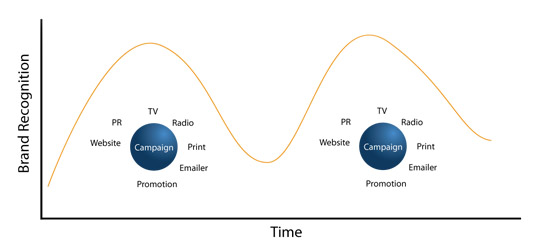
A couple of big campaigns are planned for the year. The objective: drive as much brand recognition as possible using a number of marketing channels; TV, Radio, Print, Trade Shows, PR, Internet Ad spend and perhaps throwing in an Email Campaign. No direct communication plan. No social media strategy.

The problem…


If one had to measure the effectiveness of these campaigns over time, it will be noted that the brand recognition curve peaks midway through the campaign and then decreases rapidly into that "quiet" period in between campaigns, until a new campaign kicks in again. Assuming that brand recognition translates into sales, this does not deliver a constant flow of sales. A fairly simple analogy, but I think you get the point.

The solution…


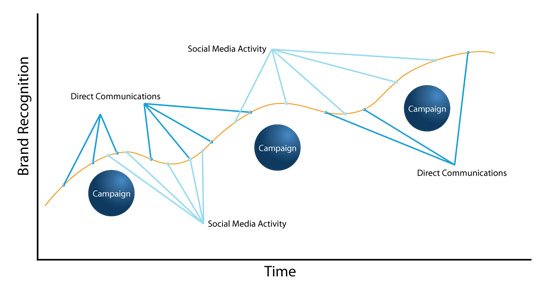
Marketing strategies should look like this:

This translates into the following:

  • Spread the budget across slightly smaller campaigns and constant direct communication
  • Effectively reduce specific campaign budget spend, whilst shifting resources to a direct customer lifecycle communication programme that is targeted, relevant and cost effective throughout the entire year and not just once off 'spray and pray' blasts
  • Invest in a social media programme to monitor conversations in the social space, and drive a loyal brand following

The cost of delivering direct digital communications programmes is far less and arguably achieves a better ROI.

To sum it up - By reducing specific campaign budgets and allocating additional funds in a constant direct communications programme throughout the year, while supporting it with a social media strategy, you mitigate the "quiet" periods and drive the brand recognition curve higher.

Always communicating. Always top of mind.


Assuming again that brand recognition translates into sales, to ensure consistency, use direct communications and social media constantly throughout the year, in conjunction with smaller more targeted campaigns. This is a far better marketing strategy.

For more tips on how to harness the power of digital communications, chat to an eMarketing Specialist.

Wednesday, February 23, 2011

Don't forget the basics when testing email campaigns

Email marketing is constantly evolving and a focus for many companies is split testing to ensure relevance and understanding of customer behaviour. However, it's easy to forget the basics and that's when mistakes creep in.

I have received numerous marketing and notification emails in the past few weeks which have the basics wrong: referring to me by my surname rather than first name (no title), reply not working and an unsubscribe process that requires multiple clicks to remove me from the list.

There is basic testing that needs to be carried out on every email campaign before distribution. If you have automated campaigns going out, test them every 6 months, even if they were correct when you launched them. Things change and anything can affect your campaign.

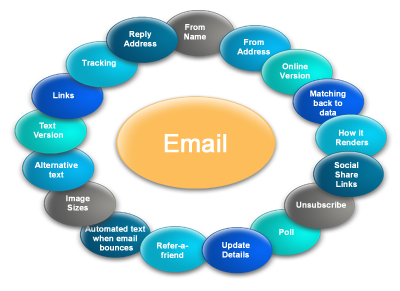
email Marketing Check listSo what are the basics?


An email is the sum of its parts. You need to test every one of those parts. Don't assume that any part of the email works if you haven't tested it.

Here are a few quick tips:


General
  • Check your email in the major browsers. Different browsers will render the email differently, so don't assume that because you checked the email in Hotmail it will look the same for everyone. Check that same Hotmail email in Chrome, IE, Firefox, Safari, etc. as each of these may render the email differently.
  • Check your email in the major email clients. HTML renders differently in different email clients. Where it looks perfect in Outlook for example, the text that should be black is purple in Gmail, so check your email in every email client possible.
  • Remember that more and more people read these emails on the go, so test how the email looks on mobile devices and how easy it is to read, click and navigate through it.
  • When last did you test the reply? Finger trouble when setting up the campaign could mean that your reply address isn't working. This is damaging to your brand and will impact on deliverability.
  • The most basic, but far too often forgotten test, is to check your grammar and spelling.

Data
  • Don't lose your customer at the salutation. Check that your personalisation and customisation match what is in your database. Always check random customer email samples against the original data.
  • Is your unsubscribe working? All too often this link goes unchecked and if it's not working, not only are you contravening a few laws across various countries, you're damaging your brand.

Images
  • Make sure your image sizes are specified. If they aren't, older versions of Outlook will stretch the images - forcing recipients to scroll left and right as well as up and down unless they download them. Newer versions of Outlook make the images 1 pixel high and wide before download.
  • Have you included alternative text behind the images? A recipient should understand the email and see all the call to action buttons without having to download the images.

Landing pages
  • Does your customisation and personalisation pull through to the online version? If you're making the effort to be relevant and customise communications, then ensure that the online version mimics the email.
  • Make sure that the online version link does not appear on the online version.
  • If you're logged into Skype, telephone numbers will be converted to a specific style with a flag, which could break the template so check your email and the online version whilst being logged into Skype.
  • Are your landing pages named correctly? They should have the name of the campaign or the subject line.

Testing email campaigns is vital to ensure their success and to preserve the reputation of your brand, so ensure you are testing thoroughly before distribution. If you still aren't sure whether or not you are covering all the basics, be sure to chat to an eMarketing specialist…

Mia Papanicolaou
striata.com

Wednesday, January 26, 2011

The Digital (non) Dialogue

Today I received an email from a bank with the subject line: Private Bank: Your direct access to Top Management.

The email started off with: "At XX Private Bank, we're well aware that your time is your greatest luxury . . ." and ended off with the Regional Manager's personal details.

First problem: I'm no longer a customer of this particular Private Bank, and haven't been for upward of a year (but that's for another rant . . . I mean blog post, entitled "Please manage your data").

Second problem: it was addressed to DEAR PRIVATE BANK CLIENT. Enough said.

Companies still treat email communication as a monologue


What horrified me the most was that the email came from a no-reply mailbox.

Frowning, I looked through the rest of my regular supplier communication, and guess what? There are still loads of companies that treat email communication as a monologue. Unbelievable!

This business of sending emails from a noreply@company.com address and actually advertising in the content that "this mailbox is not monitored", is just plain bad practice. Why do they think it's okay to push out email communication without a reply path? Is my time less important than theirs?

Companies reap the cost and efficiency benefits of sending emails to customers: transactional notifications, personalized documents, triggered communication – all cost much less to deliver electronically than a phone call or posted letter.

Why make it less than 100% convenient for the recipient to send back a reply?

Don't you want your customers to engage with you?


Your marketing department spends millions trying to get your customers to engage in a dialogue with your company. There's a whole team of people paid to find out what customers think. Yet communication that is guaranteed to be sent to customers, such as statements, invoices, transactional notifications, are often treated as monologues.

Not to mention the deliverability problems that come along with having "do not reply" in the email address or body copy. Have you tested your delivery rates on no-reply emails? You'll be shocked at how many don't get delivered or get pushed straight to junk mail folders.

Worship the dialogue


Appoint a team to take charge of managing responses to your outgoing electronic communication. A lot of what you get back might be rubbish, but can you really take the risk of missing the pearl of wisdom in a suggestion from a customer? Or worse, ignoring the desperately disgruntled customer who takes his comments into the public domain after receiving no reply from you?

Inbound message management doesn't require a massive call centre. All you need is a team of well trained agents using decent electronic messaging software that manages inbound communications in the same way as you manage inbound calls. There are applications smart enough to filter spam and bounce backs, and to route emails based on your customer service business rules. This is not rocket science.

You have to encourage the dialogue, nurture the conversation and value the feedback. And making it difficult for customers to engage with your company is just plain bad practice and a missed opportunity.

[This is an automated blog post. Please do not reply.]

Alison Treadaway
www.striata.com

Tuesday, January 18, 2011

7 Email marketing trends for 2011: it's back to basics

I spent some time this past month researching what email marketing and communications trends we can expect to see emerging in 2011. The common theme I found is:

Continued economic pressures, increasing customer demand and advancements in email technology (i.e." Smart" inboxes) means marketers will have to continue to find ways to do more with less, more effectively and more efficiently to produce greater results.

As marketers; what should we be doing in 2011 to overcome these challenges?

My 7 trends to maximise email communication results and efficiencies

Trend 1: Data management - growth, maintenance and hygiene

With international legislation protecting the rights of consumers, you simply have no choice but to ensure your data is well managed and maintained throughout the customer lifecycle.


Your data is the foundation on which your Lifecycle Communication Programme is built and should therefore be the number 1 strategic objective of your marketing strategy and hence a continuing trend into 2011.

Trend 2: Segmentation and relevancy

The more you know about your subscriber base, the easier it is for you to craft content and offers into communications that are relevant to each subscriber. Whether it is preference data captured during the customer's lifecycle, to past behaviours and activity tracked and recorded, you should be profiling each and every customer.


Segmentation and relevancy is important for a number of reasons, but none more so than ensuring your email stands out above the rest – we see this as a key trend gaining more traction in 2011.

Trend 3: Customer lifecycle communications

We predict a shift towards more automated triggered communications in 2011. Companies will attempt to automate as much of their customer communications as possible. Not only does it require minimal effort, but the impact is significantly higher with better response rates.

Trend 4: More social media integration

As marketers begin to understand the symbiotic relationship between email marketing and social media, the trend will move towards more consistently integrated campaigns. For those marketers who have yet to understand and embrace the social media space, 2011 will see those marketers including simple share functionality on their communications at the very least.

Trend 5: Greater mobile integration

It is widely accepted that mobile penetration is significantly high in most countries when compared with the computer and smart phone adoption is climbing rapidly. As a result, a large proportion of mobile web use is spent checking email.

So 2011 will see a greater demand for "mobile friendly" versions of email communications that can be read on mobile devices.

Trend 6: Deliverability and authentication

Proper attention needs to be placed on deliverability because if not managed properly it can do more harm than good.

To achieve successful email delivery, the focus should be on the full scope of an email's journey - from sender to recipient. This will be a key focus area for email marketers in 2011, especially when they see their delivery rates declining.

Trend 7: Testing and analysis

We have covered testing extensively in the Q4 of last year, and see this trend growing as companies start to experiment with their communications to achieve better results within their marketing budgets.

The next step to maximising your email communications in 2011


This blog just briefly touches on the emerging trends; I will continue with a closer look at each trend in some future blogs. Can't wait? Here are some great resources containing tips on how to prepare in advance:

Data - check out Mia Papanicolaou's blog It's all about the data!

Segmentation and Relevancy - Nicola Els says If you're not segmenting, don't bother advertising and Mia asks Is your email marketing relevant enough to make you stand out?

Customer Lifecycle Communications - I covered this topic in my blog Dear Sir. Why have you stopped communicating with me?

Deliverability - Read this edition of eMarketing Insight entitled The importance of deliverability.

Testing - check out our series on Email Testing covering Tips on how to test email subject lines, The Call-to-Action: Email Body Testing and Testing design and layout in email

Haydn James
Head of eMarketing, Striata
striata.com

Wednesday, November 17, 2010

If you're not segmenting, don't bother advertising - Improve your marketing in operational communications

A new global media report issued in October 2010 by Deloitte has revealed that online advertising is losing sway against more traditional advertising and appears to have only a minor influence on buying behaviour.

When a colleague first presented me with this fact, as written in an article of a well known South African newspaper, I refused to believe it. How is it possible that online advertising can have less impact than traditional advertising, which in many ways has lost its affect on the market through overexposure? Surely online advertising is naturally more targeted than traditional marketing? My naivety seems to have gotten the better of me. After digging a little deeper and paying closer attention to advertising online (which in fact proves the point that I was not taking note of online ads), it seems the majority of online marketing is not targeted at all.

So how does this relate to email?

It naturally follows the same line of thought. If you are including marketing material in your operational communications or sending purely marketing related messages to your customer base and not segmenting and targeting this base accordingly – you are wasting your time!

You have to employ a new strategy for digital advertising if you expect your customers to interact accordingly with your brand. Print and digital marketing are far removed from one another, yet the same methodology is applied by many marketers.

Know your customer & use appropriate trigger points

Create a Customer Lifecycle Management strategy that maps your customer's interactions with your company - from on boarding, management and retention through to the sometimes unavoidable possibility of your customer leaving. Each of these customer phases and the additional interactions they have with your company during this time provides you with vital trigger points, which will enable you to interact further with them, via email, SMS etc.

Every company representative that interacts with your customers has a responsibility to gather additional information. This can happen after the fact e.g. a text message sent to a customer asking them to rate your company's service, following an interaction with your call centre, or during the interaction e.g. asking a customer to participate in a poll or survey from within their monthly eStatement.

The feedback you receive from these interactions goes a long way. Not only will you get to know them better, but it will also give you more insight into their requirements from your brand. Customers expect you to know them and by doing so, prefer that you communicate with them with this knowledge in mind. When you have enough knowledge about your customers, segment your base and start to target your communications.

Over and above this, if you are not communicating effectively and regularly with your customers, you are not top of mind. In the myriad of email and mobile communications we receive on a daily basis; where does that leave your brand?

In short, when you have the tools available to create intelligent, customised communications that target the needs and interests of individual customers – use it. Many of your competitors already are...

Nicola Els
Head of eBilling
www.striata.com

Wednesday, November 10, 2010

It's all about the data!

The European Email Marketing Conference highlighted the same themes as every other email marketing conference over the last year: the importance of data, relevance, targeting and customer engagement. So I have to ask the question - if we all understand that these topics are important, why are so few companies making significant inroads in these project and process areas?

When I considered why companies aren't progressing to a greater extent in these areas, the answer was simple: data is at the core of every one of the issues highlighted and getting relevant data is easier said than done.

Without the correct data, embarking on a successful email marketing programme is impossible. You need the data in order to remain relevant, target your customer base and to trigger communications - not only when an action is taken, but also based on matching preferences against upcoming events.

What data do you have?
Getting the required data out of company legacy systems can be tough. Add to that the challenge of dealing with people who might not understand the requirement (ever tried explaining to the IT department why it's important that you have all the data?) Once you have the data you need to start slicing and dicing it - a task that could require the skills of a data and/or business analyst, which is a resource that most email marketing departments just don't have available to them. It doesn't end there - the task can get increasingly complex.

Do you have all the information?
Of course the above assumes you have all the data required. For the most part, databases have the bare bones when it comes to information, creating the need to launch campaigns, in order to augment the data on the database. It takes time to get the required information and of course there will be some customers on the database that just won't supply it.

Is the data current?
Another problem is that data ages. For example, preferences could have changed over time or - if your database makes use of age ranges as opposed to birth date - eventually you will no longer know the age of your base. Added to that, people move around and so contact details change. This creates another requirement to launch database updating campaigns.

So what is the solution?
Take it one step and one day at a time. Work with your email service provider to map out the actual data required for your triggered and targeted email campaigns and roll out projects to augment and update the data needed.

Implementing a successful email marketing programme that is relevant, targeted and triggered at customer touch-points takes time. Plan your strategy and focus on the data. Once you have the data, the rest will start falling into place.

Here are some tweet takeaways from the European Email marketing Conference from @tamaragielien: http://www.b2bemailmarketing.com/2010/11/main-takeaways-from-the-european-email-marketing-conference-2010.html

Mia Papanicolaou
www.striata.com

Thursday, August 26, 2010

Dear Sir. Why have you stopped communicating with me?

For anyone living in South Africa, just the mention of the words "City of Johannesburg" or "Municipality" is enough to make you want to pull every last remaining hair out your head...

My year long tantrum started when I received a R120,000 (about $16,000) utility bill from my local municipality for water and electricity consumption, of which water constituted 95% of the bill. Now this would not have been that unusual or surprising if I happened to be "running a small bottling plant in my backyard and I was illegally distributing my own private label mineral water" as suggested by a rather unhelpful and rude customer service agent!

However, since I am not the type of character that would perpetrate such a crime, and the fact that I don't spend 4 hours a day in the shower trying to perfect my Pop Idol audition song, then this clearly had to be a billing error that could be resolved with a quick phone call or
email. No problem! Right?

Now before I continue my rant, I never had any preconceived idea that I would have a direct line into the Mayor's office, but I did have an expectation to be able to communicate with someone.... anyone. Boy was I in for a rude awakening!

So where did it all go wrong?

Well unbeknown to me at the time, I actually had a burst underground water pipe. So the first month of "unusual" consumption they simply stopped communicating with me! No statements for 6 months. No alerts to say that an abnormal consumption reading was taken. No payment reminders. No letters of demand.

I'm surprised that they never even attempted to communicate with me by cutting off my lights and water supply – I think I might have got the message then don't you think? No, rather let my account build up to R120,000 and then switch on my statements after 6 months so I can
experience the pleasure of a mild heart attack. Not cool!

So naturally the thing for me to do was to resolve this error as quickly as possible, and herein lay my second problem. Trying to communicate with the municipality!
  • Using the Call Centre number advertised on the website – couldn't get through... ever!

  • I sent numerous emails to a designated customer service address – no response in 9 months... and counting.

  • No other communication channels were available to me like a web form or even a fax number

  • My last resort, a visit to the Customer Service centre, not very convenient in the high tech digital age if you ask me.
the various channels that are provided to me as a consumer only to be met with the sounds of silence. I hate being ignored!

The good news however is that, I eventually managed to resolve the matter by making contact with the water supplier directly. Who after investigation detected the leak, and duly admitted fault on behalf of the Municipality. They subsequently wrote off the R120,000 charge for
actual consumption, which could have been avoided and rectified if they had only communicated with me from the beginning.

The following questions have to be asked: Why? Why stop communicating with me in the first place? Why was the process so difficult? Why was it up to me to navigate through a maze of
communication channels, departments and companies to have my query resolved?

The fact remains - I don't have a relationship with the water supplier, I have a relationship with the municipality – I consume their products and services, they invoice me, I pay them, therefore I want to be able to communicate directly with them via all possible channels, and
I also want to be communicated to, when the need arises. Simple as that!

The lesson of this experience is this:

Companies run the risk of suffering irreparable damage to their brand and/or significant financial losses if they do not invest in sound direct customer lifecycle communication strategies . They spend fortunes on their Brand Image or Brand Promise which is perpetuated in various forms of glitzy advertising media and platforms at considerable expense.

Yet, when it comes to Brand Action (how the brand actually delivers on its promise), they fail dismally, because they are unable to facilitate and engage directly with their customers when their customers want or expect to have a direct conversation with them. It is a huge #BrandFail if you ask me.

Therefore, the importance of implementing customer communication strategies (including response mechanisms) cannot be overemphasised enough. There are so few companies out there that are doing it, if at all. And with so many good multi-channel eMessaging technology platforms
available to help manage the communication lifecycle, there are simply no excuses for companies, or municipalities for that matter, to not be communicating with you during your tenure as a customer.

Note: Look out for more in-depth analysis on Customer Lifecycle Management in our upcoming posts

Haydn James
Head of eMarketing
www.striata.com

Tuesday, March 2, 2010

The eStatement is Prime (Marketing) Real Estate

An electronic statement may not be as in-your-face as an outdoor billboard or as flashy as a TV ad, but it offers many qualities that make it an ideal place to practice some real one-to-one marketing.

Regular, expected, accepted, interactive . . . all of these add up to one thing: captive audience.

You know the recipient is going to look at the eBill (there’s money involved, isn’t there?) so why not use the package as a means to excite and engage your customer? Get the content and navigation right, and you could turn your eBill into an interactive, measurable, sales machine.

Let’s talk practicalities. There are a number of locations on the eBill which offer a marketing opportunity.

The email to which the eBill is attached has one key task – to deliver the attachment. Why not put it to use to cross- or up-sell? Not only are you assured that your recipient will at least glance in that direction, but you can also measure your marketing efforts by tracking click-through rates to identify what works in that space.

I’m sure all marketing gurus wish they had that kind of feedback capability on outdoor advertising. Imagine we could measure how many eyeballs noticed a banner . . . oh but wait, you can’t interact with a banner!

Then there’s the eBill landing page: the first page the customer sees on opening the encrypted attachment. Its primary job is navigation, but there’s no reason it can’t be used to pull traffic to your latest website offering.

Standard web navigation rules apply: top right hand corner is most noticed and definitely don’t expect response to any marketing that is placed below the fold. Also don’t be tempted to make your marketing messages ‘optional’. Additional navigation choices in the eBill such as a ‘Promotions’ tab, will not pull traffic unless there is a hook, and a good one at that.

But wait, there’s more . . . remember this is a one-on-one communication so if you have the right information about your customer you can tailor the marketing messages in the eBill to promote what is relevant to that customer. Brainwave!

So what’s the drawback? Well . . . there isn’t one really. You’re already sending the eBill, adding marketing content is not going to increase the costs, and all your efforts are immediately measurable, so you can adjust your strategy as you go along.

Okay, there might be SOME people who are worried about direct marketing rules and whether the right to refuse marketing extends to the right to refuse marketing messages in an operational communication. But that’s a different discussion for another time.

Alison Treadaway
Managing Director, Striata Africa
www.striata.com

Monday, February 15, 2010

Is December 2012 Doomsday for B2C Marketing?

December 21, 2012 is the end-date of a 5,125-year-long cycle in the Mayan Long Count calendar and some believe that cataclysmic or transformative events will occur on this date. Forrester believes that by 2012, consolidators' share of the online bill payment market will surpass direct billing by merchants for the first time. In other words, your brand, your marketing opportunities, your customers’ eyeballs will be owned by someone else. Sounds like a doomsday scenario to me. Let's explore further.

A Bill Consolidator, in the EBPP world, is an online Service Provider that consolidates bills from other Billers and presents them in a single portal to the customer. In plain English, bill consolidators receive billing data from numerous billers, aggregate and sort it by consumers enrolled in EBPP programs, then send it to distribution points based upon where individual consumers are enrolled. These distribution sites are commonly banks, but can also be Internet portal sites such as AOL, Quicken.com, and Yahoo! Finance. Examples of consolidators are Yodlee in the US and OneVu in the UK.

While the offering at first glance appears attractive to consumers who want to be able to pay multiple bills from a single location, there are a number of limitations for the biller:
  • Only summary level data is visible in the billing portal;

  • There are generally no interactive capabilities with the bills and all additional bill content (statement stuffers, regulatory notices, etc. ) are lost;

  • The biller loses control over all aspects of the billing/payment process;

  • Personalized marketing and branding opportunities are forever doomed.
There is an alternative to the doomsday situation - where the only regular touch point you have with your customer is relegated to someone else - It's called Consumer Consolidation, and the vast majority of your customers already do this in their email inbox.

Consider the average internet user: typically the first application to be opened every day and the last to be closed at night is the email client. Incoming emails are usually dealt with soon after they are received, as opposed to paper correspondence, which often lies on the kitchen table until the end of the week, or longer. Emails are filtered and sorted either according to sender or types of email, making them easy to retrieve. Imagine if the email inbox could be used as the central repository for bills and payment. For the consumer, this is the height of convenience:
  • Bills are received electronically, in one place, with personalized filing and sorting;

  • Bills can be paid without having to log into countless portals with their necessarily long and complicated access credentials.

For the biller, the benefits of being able to communicate directly to their customers instead of relying on the consumer to log into either their own portal, or worse someone else's, represents a paradigm shift in electronic billing. Most importantly, it avoids the B2C Marketing Day of Judgment predicted by Forrester.

Michael Haupt
Managing Director, Striata Europe
www.striata.com

Tuesday, August 4, 2009

Rising postal costs result in increased online usage, which again causes rising postal costs.

The United Kingdom (Dec 2008) and the United States (May 2009) both 'suffered' at the hands of their national mail carriers, as costs of first class mail increased.

Why the increase? The National Carriers are suffering revenue losses, as a result of the increased use of email and social networking. The postcard is a quaint relic from the past; pen-pals from even further back in time; love letters have become text messages; event invitations have become the doyen of Facebook, Google forms and the like.

The recent global financial strains have also forced organizations that communicate with their customers via 'snail' mail to investigate alternative channels of communication

The Striata Solution set is ideal for the abovementioned scenarios.

The eMarketing Suite provides significant functionality, which effectively facilitates the distribution of various communications to the client database. Provision is made for the collection of data at each point of contact, while the email content can be tailored to the particular client’s profile. Furthermore, the Striata Application Platform provides significant deliverability features and benefits.

The eBilling Suite is usually used to attach an encrypted document to an email. The encryption is built by either the Striata Encryption Engine, which stores the designated file in the proprietary Striata Reader (a file with the following file extension: .emc); or the Striata PDF engine, resulting in an encrypted PDF.

While these solutions do not assist the mail carriers in limiting their price increase, they do provide organizations that distribute paper based communication with an alternate delivery channel – one which is cost efficient, immediate, trackable and environmentally friendly (green).

So, it is inevitable, the mail carriers will continue to increase the postal rates to mitigate their loss, resulting in more and more organizations turning to electronic communication and delivery as an alternative option – this enables them to manage their communication initiatives, more efficiently and cost effectively.

Thursday, July 16, 2009

Demystifying TransPromo

What is 'TransPromo' – a movie with Felicity Huffman?

No. The term is given to communication that provides the dual functionality of Transactional documentation and Promotional material; and it is used, most effectively, in the realm of electronic communication.

The biller asks: How can we apply it electronically?

You previously sent your bills / invoices / statements / etc by post and your marketing department came up with a great idea to send your latest promotions or specials in the same envelope. These were referred to as bill stuffers. Anyway, the point is that the recipient, received a nice bit of marketing delivered directly to them.

Now you use electronic document delivery, as the opportunity for cost saving, increased delivery rates and reduced days sales outstanding (DSO) convinced you that this was the right way to go (shameless plug). But your marketing department is far from impressed - how are they supposed to get their marketing material, that was traditionally the ‘bill stuffer’, to the consumer without ramping up their delivery costs?

The answer is simple - the cover letter of the email and the white space of the actual document provide the perfect opportunity for the marketing department to incorporate their promotional messages. Not only are you resolving the bill stuffer issue, but their promotional message is now part of the bill, not an extra bit of paper that can easily be disposed of.

Very neat.

The consumer asks: What do I get out of this?

A warm fuzzy feeling, because you know that your biller is saving the environment; and also the hope that the cost saving they have experienced as a result, is passed onto you

I like reading promotional offers. Obviously the fine print is crucial in determining the actual benefit for me, but if I didn’t get this information, then I wouldn’t know if the product I currently use is most suited to my current or future needs.

I agree that it may be a relief not to encounter the bill stuffers along with the extra admin of chucking them away every month. But, as we understand that the best way of finding out about new products and services is when sales people advise us of them, so we understand that the use of electronic TransPromo documentation does benefit us as consumers.

TransPromo documentation

The biller sends an electronic invoice / statement / bill / document / etc to the consumer. Instead of adding extra marketing documentation or sending subsequent promotional communication; the biller incorporates the promotional material into the same message as the billing information, so that the promotional information is passed onto the consumer.