Wednesday, March 16, 2011

eBilling greenwashing is hogwash

eBilling is "green" – everyone knows this. It's a truism so obvious and self-evident that it is hardly worth mentioning. So, for eBilling to be attacked as 'greenwashing' seems disingenuous to say the least, especially coming from a lobbyist bought and paid for by the very industry suffering from eBilling's success.

Recently "Two Sides" (a lobbying initiative by companies in forestry, pulp, paper, inks and chemicals, pre press, press, finishing, publishing and printing) started beating their drum about the "Greenwashing of eBilling". They maintain that in the UK 45% of major banks, 70% of telecoms, and 30% of utilities risk greenwash sanctions for claiming that eBilling was "green" without verifiable proof.i

The issue that upsets them so much is that the banks, telcos and utilities are enjoying substantial cost reductions from moving to electronic billing and therefore can't claim to be doing it for altruistic environmental reasons like saving the planet and lowering Co2 emissions.

And they are particularly upset because their bankrollers are seeing revenue decline as customers choose to "Go Green" by going paperless. It seems to be a fairly self serving argument – but I guess that's their job.

It is interesting that Two Sides are not disputing that eBilling is more cost effective – but they are harping on the technicalities that the organisations making the claims have not done the "verifiable research" to back-up the "green" claims and therefore could be "contravening the latest CAP code (Committee for Advertising Practice) which states that environmental "claims must be supported by a high level of substantiation".ii

Of course to some people it may not seem that obvious that an email is going to result in less pollutants than a piece of paper. There are no trees to cut down, no effluent waste water and no solid waste in the production of emails.

Two Sides point out that the data centres are needed to host and run the eBilling processes consume vast amounts of power but interestingly enough they don't provide any verifiable research to back this up. Common sense would dictate that the power consumption is not a significant factor in comparing the "green" credentials of eBilling vs. paper & print as similar servers would be used in both process, except in the case of eBilling there are no massive printers to run and no network of delivery trucks to distribute the documents – eBilling uses a tiny piece of an existing network (the internet) and such a small proportion of the end users computer power as to be statistically negligible.

Two Sides goes onto say that "Print Media... being based upon a renewable and recyclable material, may be the sustainable way to communicate."

What a load of Hogwash!


Just because trees are a renewable resource doesn't mean that paper is a sustainable way to communicate. This is so self-serving it stinks more than the sulphuric smell that pervades pulping plants.iii

In its submission to the European Commission on Electronic Invoicing, Two Sides urged the Commission "to recognise the economic benefits derived from the paper, printing and postal... as thousands of jobs and livelihoods are wholly or partly dependent on the wider paper, printing and postal industries", i.e. please don't eat our lunch.

Unfortunately for Two Sides, the cat is well and truly out the bag on this one. eBilling saves costs as it turns off paper. Market forces will dictate that businesses drive down costs and eBilling is a prime opportunity to do that. If this means that the bankrollers of Two Sides feel the pinch – that's just normal business – there's no use whining about it.

As for the 'verifiable research' you only have to visit www.papercalculator.org to work out the environmental benefits from switching from paper to email. In addition, here are a few links that provide more information and proof that paper is a messy business:


i http://www.twosides.info
ii http://www.cap.org.uk
iii http://www.rfu.org

Wednesday, March 9, 2011

What happens when companies don't invest in Direct Customer Communications?

I would love to be a fly on the wall when marketing departments are thrashing out plans for their marketing campaigns at the beginning of the new financial year.

I am willing to take a bet that in general, direct digital communications - considered the ginger-headed step children of marketing disciplines - receive mere scraps of the budget pie, whilst the glamorous fat cat traditional and significantly more expensive media channels take the lion's share. This translates into a minimal requirement for a comprehensive digital communication strategy, as there is relatively little money left to allocate to it. And this is where it all goes wrong.

I do admit however that this strategy is slowly changing, as social media is gradually being included into marketing strategies, but frankly it is not happening fast enough.

To illustrate my point…

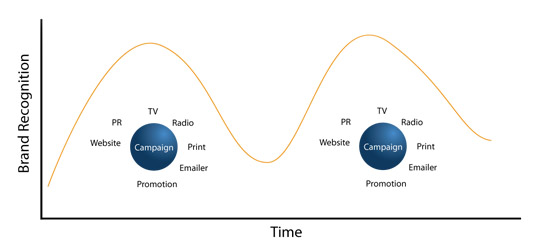
I believe most companies' marketing strategies look something like this:
A couple of big campaigns are planned for the year. The objective: drive as much brand recognition as possible using a number of marketing channels; TV, Radio, Print, Trade Shows, PR, Internet Ad spend and perhaps throwing in an Email Campaign. No direct communication plan. No social media strategy.

The problem…


If one had to measure the effectiveness of these campaigns over time, it will be noted that the brand recognition curve peaks midway through the campaign and then decreases rapidly into that "quiet" period in between campaigns, until a new campaign kicks in again. Assuming that brand recognition translates into sales, this does not deliver a constant flow of sales. A fairly simple analogy, but I think you get the point.

The solution…


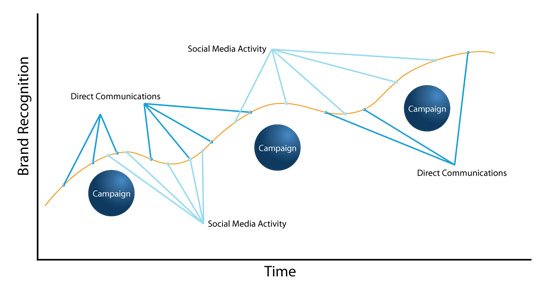
Marketing strategies should look like this:

This translates into the following:

  • Spread the budget across slightly smaller campaigns and constant direct communication
  • Effectively reduce specific campaign budget spend, whilst shifting resources to a direct customer lifecycle communication programme that is targeted, relevant and cost effective throughout the entire year and not just once off 'spray and pray' blasts
  • Invest in a social media programme to monitor conversations in the social space, and drive a loyal brand following

The cost of delivering direct digital communications programmes is far less and arguably achieves a better ROI.

To sum it up - By reducing specific campaign budgets and allocating additional funds in a constant direct communications programme throughout the year, while supporting it with a social media strategy, you mitigate the "quiet" periods and drive the brand recognition curve higher.

Always communicating. Always top of mind.


Assuming again that brand recognition translates into sales, to ensure consistency, use direct communications and social media constantly throughout the year, in conjunction with smaller more targeted campaigns. This is a far better marketing strategy.

For more tips on how to harness the power of digital communications, chat to an eMarketing Specialist.

Wednesday, March 2, 2011

Part III: Why & how email delivery is succeeding, where eBill Consolidators are failing:

My first two blog posts on this subject dealt with why consolidators here in the US will never work. In today's post, I cover the comparison between eBill / eStatement consolidators and true electronic delivery solutions:

There are five primary areas where email delivery of bills and statements succeeds, where consolidators have and will continue to fail.

1. Biller and consumer critical mass:


Why consolidators fail: To benefit consumers; consolidators should have the majority of a customer's bills in a central location. Due to the size of the US biller market this is simply impossible.To date, even mature consolidators that have been building a base for several years, have failed to exceed 20% of the average household's bills. The new entrants to this segment are yet to realize the futility of this endeavor.

On the flip side however, biller's won't subscribe to a service without a significant percentage of their consumers already enrolled. A true chicken and egg scenario.

Why email delivery succeeds: As the bill is delivered directly into the customer's inbox, it makes no difference whether it is one email bill or several a month. Just like in the physical mail scenario, getting one bill or many is just as convenient for both biller and recipient. Most importantly, it gives each and every biller the ability to deliver bills to their customers, without the need for a location to gather a critical mass of consumers.

2. Registration / enrollment:


Why consolidators fail: A recent survey conducted by InfoTrends showed that of the 1,042 consumers surveyed, 61% said that remembering multiple unique usernames & passwords remains a significant barrier to paperless adoption. Convincing the majority of consumers to register on biller's websites has proven to be an insurmountable marketing feat. For the consolidator however, it's even worse, as the customer has to have many pieces of information at hand for each biller at that location. Add to this the fact that consumers do not want another mailbox nor to have to choose and remember yet another username and password.

Why email delivery succeeds:
Quite simple - there is no registration process. The bill arrives in the customer's existing email inbox and is opened using a secure 'shared secret' (not a password, rather personal details known to the biller and the recipient). There is no need to choose or remember anything. There are also no marketing dollars required to drive the customer to sign up for anything.

3. Paper suppression:


Why consolidators fail: For a consolidator website to be considered successful at paper suppression by any biller, they will need to achieve suppression rates in excess of 10% per year, per biller. Currently statistics show that less than 5% of consumers enroll at consolidator websites and 50% of those still don't go paperless - the math cannot hope to add up.

Why email delivery succeeds: By delivering the bill or statement as a securely encrypted email attachment, the recipient can opt to go paperless with just one click - no form to complete, no website to visit, no username & password to complete, in fact, nothing to do at all except simply receive an email.

4. Bill stuffers / electronic marketing:


Why consolidators fail:
Due to the website nature of viewing bills at a consolidator, within a multi-biller environment and along with the fact that the biller does not have any ownership of the viewing real estate, marketing to consumers at consolidator websites is a considerable challenge, if offered at all. There is certainly no advanced personalization possible.

Why email delivery succeeds: It is automated and extremely cost effective to insert and overlay marketing messages into the body of an email, the white space of the bill and entire pages inserted into the secure attachment. Furthermore, this can be personalized down to the individual recipient, resulting in a bill marketing tool that is significantly more powerful than the paper bill, the biller's own website and definitely any consolidator.

5. Mobile:


Why consolidators fail: Navigating a mobile website or downloading an app is just inconvenient, a poor user experience and requires pre-registration. In addition, paying through a mobile website is an even worse experience than just viewing it. (To date no consolidators have offered a mobile option, but we believe that in 2011 there will be a first attempt.)

Why email delivery succeeds: An email attachment can be opened on any email capable device, without the need for the recipient to do anything. In addition, the same email will be waiting on the recipient's computer for viewing later. Payment can be initiated with just a single click.

And finally it is relevant to point out that where new consolidator entrants are in start-up / concept stage, secure electronic document delivery via email has been successful in 14 countries (including the USA) for 12 years, for more than 250 large Billers and Financial Institutions, including 3 of the top 10 banks).

When considering your paper suppression strategy, do you go with a new idea that has never worked before, but is at best a 'nice' idea, or do you chose a direction with a decade of referencable, proven success stories?

Garin Toren
striata.com