Friday, November 5, 2010

Email, at your service - as always

In the late 70's, Japanese electronics companies introduced the fax machine to the masses and businesses were poised to never buy another stamp again. Over thirty years later, with the number of pages sent per year exceeding 200 billion in the United States alone, I still see the mailman three days a week.

Email made the same promises not so long ago and even though the number of email users will increase to 1.9 billion in the next few years, the only dead medium at this stage is the telegram.

Email is too ingrained in our lives to become a "dead" medium

There has been a lot of talk in the blogosphere and at conferences aboutthe future of email, with big names in social media even laying down the gauntlet by declaring it a "dead" medium. Even though there has beenmassive growth in social media registrations, typically surpassing new email uptake, there is still a lot to be said for the faithful email.

Asa service originally intended for "techies", its simplicity has allowedit to evolve alongside newer technologies. From the personal email replacing the informal letter to the invaluable business tool used by every corporate employee, email has become a ubiquitous service in our daily lives. Just a few years ago, email was limited to the work desk and maybe a bulky desktop at home. With the advent of the mobile revolution email has become a vital part of our daily lives, right therein our pockets keeping us in touch (almost) 24 hours a day so it's easyto see how a technology loses its excitement when it becomes so ingrained in our lives.

Email is a necessity

Being ingrained in our everyday lives is, of course, a good thing. It ensures the longevity of the medium as it has long since been upgraded from a convenience to a necessity. Spam is now largely under control with better software, filters and practices giving emails a more "official" feel. This gives the sender not only a duty to uphold the validity of their communication but also an advantage that was non-existent previously. Many customers are now expecting the emails they receive to be worth their while and no other medium provides this freedom.

By allowing targeted information and marketing, transactional data and the ability to receive personalized feedback all to the same inbox, the email address still remains the most important known piece of customer data.

To get the most out of this valuable tool you need to consider all aspects of email including distribution, best practice, effective campaign concepts and appropriatecalls-to-action.

You may own this incredibly valuable piece of customer data but are your email communications maximized for best response?Alex Papadopulosstriata.com

Wednesday, October 20, 2010

If you’re already talking, why not make it more worthwhile?

To be honest, I never really saw the point of blogging. Writing random pieces to relate a topic back to my everyday life was a notion I didn't buy into at first. But our website stats and the feedback that we've received from our partners, customers and prospects in response to our regular blog posts has proven me wrong.

Pushing the blog has increased readership

The fact is that everyone in Striata and on our mailing list has a common interest – electronic document delivery – and this type of regular, informal communication helps to build a stronger relationship between us. Each week some new ideas or a different perspective on accepted views are put out there to hopefully get people thinking and maybe inspire changes to the way things are done. But mainly, it lets everyone know that we're passionate about what we do, that we have opinions and ideas and that we are keen to share our passion with our clients, partners and other contacts. Plus of course "pushing" our blogs out to you dramatically increases the readership. I mean, you're not going to visit striata.com every week just for fun to check and see if I've written something interesting/witty/useful, are you?

This all got me thinking about other companies' regular communications with their customers. We often hear that the bill is the only regular touch-point between a company and the customer. But, standing alone is it a good customer touch-point? Does it add value to the relationship? Generally, the best you can hope for is that the customer isn't upset at the amount due of their bill. No-one will ever look forward to receiving their bill.

What if your eBill could add value to the relationship?

So, why not use this regular communication to expand the relationship to something that isn't just money-focused? Why not include a blog or newsletter with each eBill? It may be obvious, but every company has something in common with their customers. It shouldn't take much to come up with something to tell your customers each month that will show you're interested in more than their money. Depending on the type of company, there are all sorts of things you can discuss. Product reviews eg. the iPhone vs. the latest Samsung smartphone. Tech/green updates like the latest scrubbers in your power-station chimneys or femto-cell roll-out to boost mobile coverage. Or perhaps even charitable work your company or employees are taking part in? Anything that shows your customers that you're more than just a faceless corporation only interested in the bottom line.

Of course, with paper-based billing, the cost of this sort of newsletter/blog sent with each bill would be prohibitive. But with eBilling, the cost of an additional page is negligible if anything at all. And of course you can also include a call-to-action such as a link to your website to pre-order the iPhone 5 or whatever else works for you. It's about giving your customer informative, unbiased and engaging information or offers. Just a thought, chew on it!

Keith Russell
Sales Director, Asia Pacific
www.striata.com

Wednesday, October 13, 2010

What the new era of "Smart" inboxes means for email delivery

As eMarketers and eBillers, we are constantly fighting the battle of getting every email to its destination through clever, practical design and delivery methodologies. We've had to overcome many barriers – strict spam filters, a myriad of different email software and web browsers and not to mention design and copy layout challenges to achieve maximum open rates. If that wasn't hard enough, we are now faced with another hurdle to overcome:

Inboxes that are automatically able to distinguish between important email and email that should safely be ignored. Introducing the "Smart" inbox.

"Smart" inbox - sounds so sophisticated but so what?

Inboxes are becoming more and more intelligent thanks to new features that allow users to automatically sort and manage incoming mail more effectively. The "Smart" inbox uses a range of variables and filters from sender recognition to user interaction to determine what email is deemed important and what email can be discarded or filed into an "unimportant" folder somewhere or even worse, deleted!

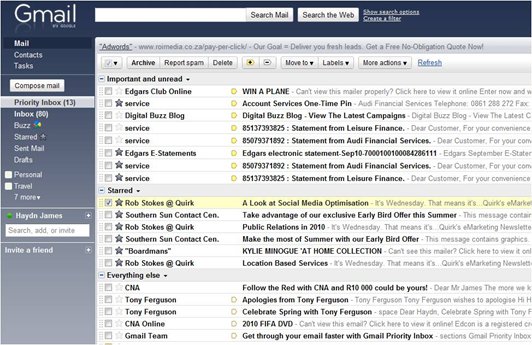
Take for example Google Mail, who just recently launched their Priority Inbox feature.


Priority Inbox

The Priority Inbox is segmented into the 3 clear categories of mail:


  • Important and Unread – The heading says it all. This is where you want your marketing messages to be delivered automatically, and where you could expect far greater open and click through rates.

  • Starred – This section is marked as important and requires follow up. You can reasonably expect that emails will be opened from this section as they have been marked by the user for follow up.

  • Everything Else – This really means, "unimportant and I'll get to it whenever I can email". Not the kind of place you want your marketing communications to end up. Chances are it is less likely that these will be read.

Using a smart algorithm, Gmail Priority Inbox analyses information, such as the addresses that you mail the most and your email usage behaviours – what emails you click on and which ones you discard without reading.

Also, when the user marks messages important or unimportant, the algorithm adapts itself as it learns and understands what type of mail they deem as important and what is generally not. Plus future messages will be treated in the same way, without the user having to do anything.

What does this mean for you?

The "Smart" inbox has major implications for marketers and companies wanting to communicate with their bases. Gone are the days where we can assume that emails are generally going to appear in an inbox sorted by date received. Now more than ever we should be applying best practice to email design and delivery.

On the plus side, the rewards for delivering wanted, relevant messages are that your emails get priority positioning in an uncluttered inbox.

Conversely, the penalties for getting it wrong result in poor inbox positioning or worse, it may never reach the inbox at all.

What then should you do to ensure priority positioning?

Here are a number of things you should be doing:

  • Segment and profile your base so you can tailor your communications to be more relevant to your customer. The more relevant the communications, the greater the chance of it being opened and/or marked as important

  • Send effective welcome messages – there is no better time to tell your customers to add your sender address to their contacts list and describe what communications they can expect from you. Also, use it as an opportunity to educate them on the importance of marking messages as important or "starring" them for later reading

  • Review the design and copy of your communications ensuring you have included strong subject lines and pre-headers. Also ensure you find a good balance between text and images so your email can be scanned quickly in the preview pane when images have not been downloaded yet.

  • Drive meaningful interaction with your customers by ensuring you have strong, visible and readable calls to action. Include social media sharing capabilities and where possible include features such as call-me-back's and polls

  • Introduce a lifecycle communication programme - Where you have a number of critical triggered transactional messages and important scheduled communications such as electronic statements, all sent from the same address. Due to their nature these messages will most likely be opened or marked as important by the user. So your marketing communications sent from the same address will be recognised as relevant and important too.

While "Smart" Inboxes are relatively new and may represent a small percentage of your database, the point is, the email landscape is changing. You should be changing your thinking too.


(P.S. – We used Gmail as an example to highlight "Smart" inbox concept – the other email service providers do have similar features built in as well, so this concept is not unique to Gmail. Where smaller service providers may not have this feature now you can reasonably expect that they will follow.)

Haydn James
Head of eMarketing
www.striata.com